Sunday, June 19, 2011

Tex Romero

Tex Romero believes in the saying, ‎"There is nothing so agonizing to the fine skin of vanity as the application of a rough truth" by Edward G. Bulwer-Lytton

Tex was born to godly parents in the year of the Hippies. Her dancing and writing skills manifested at an early age, followed by the honing of her singing and public speaking talents. Her sense of style is also obvious in her choice of fashion and fun.

Although she has had art workshops in the past, Tex Romero is only able to fully discover her full potential in the visual arts when she attended Cre8! Art Workshop in the summer of 2010.

Her exhibitions include:

2010
June - First Creations (The Atrium Gallery, Bacolod City)
June - Days of Summer: A Group Photo Exhitibion (The Atrium Gallery, Bacolod City)
August - Paper Roses: A Group Photo and Art Exhitibion (The Atrium Gallery, Bacolod City)
August - Open Art and Photo Exhibition (The Atrium Gallery, Bacolod City)

2011
February - Fire in the Hall (The Hall Gallery, Bacolod City)
February - Alla Prima on the Spot: A PIAF Launching (Provincial Capitol, Bacolod City)
February - Pitik Mingaw (DFA Gallery, Bacolod City)
March - Dibersyon (Casino Filipino Hotel-Bacolod)
May - Parada de las Reynas (SM East Bridgeway, Bacolod City)
May - Harvest of the Earth (Organic Market, Bacolod City)
May - Pinta-Ukit (DFA Gallery, Bacolod City)
May - Tipon-Tipon (Max's Pizza, East Block, Bacolod City)
June - Parada de las Reynas 2 (Island Trips, Rizal Street, Bacolod City)
June - Alla Prima sa Estancia (Paon Beach Resort, Estancia, Iloilo)
June - Rest and Recreation: A Visual Therapy (Calla Lily Spa, 6th St., Bacolod City)

A graduate of a bachelors degree in Arts Major in Mass Communications at the University of Negros Occidental Recoletos, Tex Romero is likewise an active member of the Art Association of Bacolod-Negros.


"Chinese New Year Morning," acrylic on canvas, 18"x24", 2011

This painting was done on the spot during the celebration of the Bacolaodiat, our city's traditional Chinese New Year celebration.

As artists of the Art Association of Bacolod, we held a painting demonstration for everyone to see, painting on the spot, alla prima and this is what I came up with, plus three other paintings I was able to do on the spot.


"In My Dreams," oil on canvas, 4'x5', 2008

Stemming from my Pink Forest painting, I was inspired to do this from a scene in Forest Park, a local resort in our city. But instead of the lovers sitting together under a tree, I decided that they kiss beside a shiny pool under the mystical trees in dreamy colors. All in all, these shapes form a larger abstract picture, that of two lovers kissing (other than what is obvious).


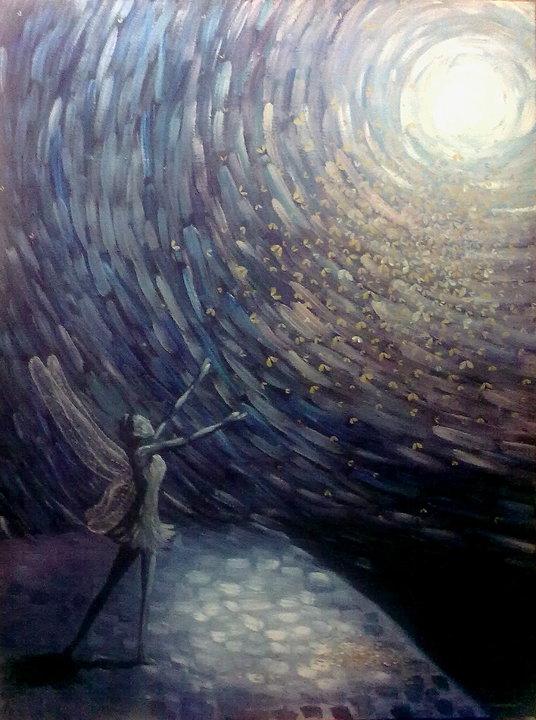
"Lumos! (Magical Lamp Post)," acrylic on canvas, 3'x4', 2010

This was inspired when my daughter struck a ballerina pose in front of a burning lamp post swarming with winged ant-like insects we call raga-raga. They usually appear during damp evenings either before or after a rain. They would gather around lights, perhaps for warmth and company.


"Pink Forest," acrylic on canvas, 18"x24", 2008

This was seen by a British national based in Hong Kong and when he saw it, he wouldn't let go of it, saying, "There's nothing like it in the whole world!" I believed him, as we eventually became friends and as I listened to his stories about London, Paris, and the rest of the art world, he was indeed telling the truth.


"Run to the Sun," oil on canvas 18"x24", 2011

A glimpse of a driveway leading to a fading sunset, I was inspired to do this at once, in impasto oil. This was purchased by an American who gave it as a gift for his father in Orange County, California.


"Morning at Masferre," oil on canvas, 18"x24", 2011

This is a breakfast window scene from one of my travels, that is, to Sagada, Bontoc, Mountain Province, a lovely and mystical place high above the clouds about 14 hours' bus ride from Manila. Masferre was a Spanish photographer who used to take pictures of the Igorot natives of the place. His descendents established this restaurant named Masferre in his honor.


"Girl on Jet Ski," oil on canvas, 18"x24", 2011

Modeled by a good friend, and at 47 still has a body to die for.

This is still available for sale.


"Romancing the Trees," water soluble oil on canvas, 2'x3', 2009

This was done on the spot, alla prima, during the painting demonstration we did at the Artekalye Festival by the Art Association of Bacolod. As I was using oil in this demo, it had to be one that will dry quickly, thus the new formula, waterbased oil paint given by an art patron from Hong Kong.


"Wood Nymph," bass relief, 10"x14", 2009

This is my first creation in wood, and is now in Singapore bought by a Singaporean named "David" during the show.


"Morning Mist," acrylic on canvas, 18"x24", 2010

This was inspired from our ballerina photo shoot at Paper Roses Beach Resort, a private seaside resort at Pontevedra, Negros Occidental.


"Aking Bayani (My Hero)," watercolor, 9"x12", 2011

I was inspired to do a portrait of our national hero, Dr. Jose Rizal. He was also an artist as well as a doctor, a writer, and many others. This time, I'm using unusual colors from residues in my watercolor palette and the effect is not at all that bad.

In fact, I may do a whole new series following this new discovery. I will be developing this "dirty painting" style that I shall call residualism, inspired from recycling old stuff or maximizing things or paints that are considered waste but are in fact still useful.

Jing Torrecampo

Jing Torrecampo discovered not only her artistic talent but her ability to pass it on to others when she started attending Cre8! Summer Art Workshop in the summer of 2010.

With her gift of teaching, she is also able to produce other talented artists in Iloilo City where she taught the Cre8! art module.

Her exhibitions include:

2010
June - First Creations (The Atrium Gallery, Bacolod City)
June - Days of Summer: A Group Photo Exhitibion (The Atrium Gallery, Bacolod City)
August - Paper Roses: A Group Photo and Art Exhitibion (The Atrium Gallery, Bacolod City)
August - Open Art and Photo Exhibition (The Atrium Gallery, Bacolod City)
September - Kami Ay Tao Rin (Robinson's Place, Bacolod City)

2011
February - Fire in the Hall (The Hall Gallery, Bacolod City)
February - April - Alla Prima on the Spot: A PIAF Launching (Provincial Capitol, Bacolod City)
February - Pitik Mingaw (DFA Gallery, Bacolod City)
March - Dibersyon (Casino Filipino Hotel-Bacolod)
May - Parada de las Reynas (SM East Bridgeway, Bacolod City)
May - Harvest of the Earth (Organic Market, Bacolod City)
May - Pinta-Ukit (DFA Gallery, Bacolod City)
May - Tipon-Tipon (Max's Pizza, East Block, Bacolod City)
June - Parada de las Reynas 2 (Island Trips, Rizal Street, Bacolod City)
June - Alla Prima sa Estancia (Paon Beach Resort, Estancia, Iloilo)
June - Rest and Recreation: A Visual Therapy (Calla Lily Spa, 6th St., Bacolod City)

Jing Torrecampo completed her secondary and tertiary education at the University of the Philippines Visayas in Iloilo City in 1988 and 1993 and finished her Law degree at the University of St. La Salle - Bacolod in 1999.

She is likewise an active member of the Art Association of Bacolod-Negros.

Alla Prima Art Circle


Alla Prima Art Circle of Bacolod, founded in May 2010, is a progressive group of up-and-coming artists named after the Italian style of painting "alla prima," meaning "at once".

Initially founded by the workshoppers of Cre8! during the summer of 2010, Alla Prima Art Circle later accepted member artists who are not graduates of Cre8! but artists of like mind and spirit.

Female members call themselves as primas, the male are referred to as primos, and children of the primas call themselves segundas.

Today, the Alla Prima Art Circle or Alla Prima for short has members from all over Negros island as well as from Iloilo, Manila, and even in the United States.

Primarily to paint for fun and friendship, it has in its roster the following art exhibitions:

2010
June - Days of Summer: A Group Photo Exhitibion (The Atrium Gallery, Bacolod City)
June - Paper Roses: A Group Photo and Art Exhitibion (The Atrium Gallery, Bacolod City)

2011
February - Fire in the Hall (The Hall Gallery, Bacolod City)
March - Dibersyon (Casino Filipino Hotel-Bacolod)
April - Alla Prima on the Spot: A PIAF Launching (Provincial Capitol, Bacolod City)
May - Parada de las Reynas (SM East Bridgeway, Bacolod City)
May - Harvest of the Earth (Organic Market, Bacolod City)
June - Parada de las Reynas 2 (Island Trips, Rizal Street, Bacolod City)
June - Alla Prima sa Estancia (Paon Beach Resort, Estancia, Iloilo)
June - Rest and Recreation: A Visual Therapy (Calla Lily Spa, 6th St., Bacolod City)


Upcoming Shows:
July - Art & Soul (Casino Filipino Hotel-Bacolod)
August - Can't Let Go
September - Vivid
February, 2012 - With All My Art (Dizon-Ramos Museum, Bacolod City)

For artists who can paint the alla prima way, they are welcome to join our Alla Prima Art Circle.

Friday, February 19, 2010

Joan of Art Painting Lessons


For starters, I recommend to use acrylics, because it's water-based, thus safe to use for children.

1. Easel - I prefer my students standing while painting to allow more freedom of movement and in order for them to step back once in a wile to see their painting from a distance.

2. Apron or working clothes - expect paint splatters all over your clothes and skin so better protect them with an apron or better, wear old clothes while at work.

3. Canvas - buy by the meter at this telahan at the atrium beside centroplex in central market (I forgot the name! daw ong pio, I think?)

4. Canvas stretcher - your choice between two types:

a. Plywood stretcher - get the thinnest plywood you can get, ang pwede mautod sang cutter, no need lagare. It costs about P220 the whole 8ft x 4 ft, that should give you a lot of standard 18"x24" cuts (please do the math na lang kun pila). Then cut some of the 18"x24" into four 9"x12" cuts for the smaller works, or half lang at 12"x18". Now you have at least three sizes to work on. However, you must have to frame this after your artwork is done.

b. Bastidor - for smaller 9"x12" or even 18"x24" works you can use the 1"x1" and 1"x2" for the bigger ones. Kay natak-an na ko ya magpalopez-jaena to buy the gemelina lumber, sa citi hardware na ako gapamakal kahoy para nasapiyo na. But I heard other artists have their bastidor frames made at lopez-jaena at a reasonable price, without the canvas pa. The advantage of working on the bastidor is that you don't have to frame it unless you really want to, and the "bounce" of a backingless canvass is more preferred by artists than the hard press of the plywood-backed canvas.

*Note - How to stretch your canvas: it is best to staple your canvas with a gun tacker starting from the center on one side, then the center of the opposite side, then from the center of the other side, then its opposite side, working on to the corners, as shown in this illustration. If you have time, please observe how the other canvas are neatly and tightly stretched in place. Soon you will be able to get the hang of it and even develop your own stretching technique.

*Note - How to prime your canvas: in lieu of acrylic gesso which is not available in the local market, we use white DAVIES acrylic semi-gloss, as advised by our mentor for a more vibrant underpainting. We are taught to put value to our painting so that even the things that are not seen in painting have to be already good in order to give your artwork a good foundation and the luster that other paintings don't seem to have. Paint your canvas with three layers of paint but you may add more up to five coats for a better primed canvas support. Let dry. Now you are ready to use your primed canvases for your painting.

*Note - another excellent painting support is lawanit or hardboard, which is very acceptable and even better than canvas because of its more rigid surface. In fact, many of the old paintings that survived have been painted on wood panels. You have the option to paint on either side of the lawanit. Although I prefer the rough side for texture, you can also choose to paint on the smooth side, just sand it before coating it with gesso or acrylic primer and in between layers.

5. Brushes - for starters, choose cheap nylon brushes (the red sable ones) available at national bookstore. There are rounds, flats, and other types of brushes. Choose several types of various sizes. The more you paint the more you will discover a particular liking to a certain brush type/size.

6. paints - for starters, choose mid-range acrylic brands such as Reeves, Liquitex, and Grumbacher which is the ones easily available in the local market. If you buy cheap paint, you might regret it because their pigment quality are not as vibrant. Always put value to your painting so it is better to start with mid-range quality paints and move up to the more expensive ones when you have mustered more and more confidence. There are two kinds of paints, the artist grade and the student grade. The latter has less pigment because it contains more extenders. The former is of course more expensive because of its more concentrated pigments. It's your choice then which to buy. You may also buy by boxes of 12, 16 or 24 colors, but always buy an extra tube of white color. you'll be surprised at how much you will be needing a lot of white in your painting. It is better though, to buy the big individual tubes as long as you have all of these colors:

a. red
b. yellow
c. blue
c. yellow ochre
d. burnt sienna (dark brown)
e. white x 2 or 3

You may or may not buy a tube of basic green. Note: some would advise to buy only latex paint by the can, which is the cheapest acrylic paint. That may also be an option but it is not a good idea if you want to preserve your painting for a long time. But it would be fun to spill latex paint all over just for the heck of it. you can try the new elastomeric acrylics by sun and rain because it has a built in primer unlike the old latex tinting colors which has to have white as binder in order for it to stay. Primary colors red, yellow, blue, and white and also black will do.

For your tube paints, don't buy black. Real artists never use ready-made black. We will learn how to mix our own, more dramatic black.

7. Palette - cheap plastic ones at national bookstore will do. Or any old glass plate will also serve the purpose.

8. Water mister - the kind you spray your orchids, no fertilizers, of course. This will help delay the drying of acrylics because unlike oil, acrylics dry fast. Because we don't have retarders (chemical solution that is added to acrylics to delay drying time), we use water to extend the wetness of acrylics.

9. Old cloth - to wipe away paint splatters and mistakes.

10. Old newspapers - to protect the floor.

11. Sketch pad - for sketching your studies.

12. Mongol 2 pencil - for sketcing. no erasers, no rulers. we do freehand drawing. the more mistakes, the more learning!

13. Original photographs - for originality and copyright concerns.

14. Water containers - for washing your brushes (old mugs or clean gatorade bottles will do)

15. Mineral water jug caps - or gatorade bottlecaps or similar containers for smaller dips to control water splashes (and to conserve mineral water which we will use in the actual painting).

16. Old wine bottles - for still life arrangements

17. Round fruit - for still life arrangements (because they have simpler shapes than a bunch of bananas or a pineapple, unless you are ready for the challenge)

*module - my art lessons are based on God's creation, therefore...

The First Day
Night and day - a study of light and shadows. 1 session.

The Second Day
The separation of the waters - a study of seascapes and cloudscapes. 1 session.

The Third Day

The first appearance of dry ground - a study of landscapes, trees, flowers. 2 sessions.

The Fourth Day
With the sky now clear, the sun, moon and stars were dependably visible. 1 session.

The Fifth Day
Great numbers of birds and sea creatures - a study of birds and fishes. 2 sessions.

The Sixth Day
Vast numbers of land animals. Man - a study of animals, man (face and whole body). 3 sessions. Total: 10 sessions.

The Seventh Day

God rested from all the work of creating that He had done - exhibition (optional).

Fee: P100/pax if more than two students, P150/pax if one or two students only. On a per session basis, because you can never really count the hours when you're painting.

Tuesday, January 19, 2010

Children's Performance Arts Workshop Take to the Streets


Joke Van Kerckhove (YOW-kuh van KERCH-ku-vuh) came all the way from Belgium to organize a theater workshop for children of low-income families in depressed areas of Bacolod City.


With the help of NGO worker Grace Abella, they organized a street presentation of the theater workshops learned by the children.


Inday Espina-Varona and Anamarie Palermo graced the ocassion on January 10, 2010 in front of Nune Alvarado's food and art haven, Namit-Namit Pagkaon kag Taliambong along Artekalye Street, Bacolod City.

Monday, January 4, 2010

New Year's Eve Installation Art


Installation art, according to Wikipedia, describes an artistic genre of site-specific, three-dimensional works designed to transform the perception of a space. Wikipedia continues that this art genre incorporates a very broad range of everyday and natural materials, which are often chosen for their evocative qualities.

This installation art is the result of our New Year's Eve partying: traces of leftover food, fruit peelings, spoons, forks, a wine bottle, trumpets, inflatable ring, coin banks, used firecrackers and sparklers strewn all over. What an artsy way to welcome the New Year 2010!

Tuesday, December 15, 2009

Anima: A Photo Exhibition by Inday Espina-Varona


Inday Espina-Varona opened Anima, her first solo photo exhibition on December 13, 2009 at Namit-Namit Pagkaon Kag Taliambong Restogallery, Bacolod City.


They say that what differentiates a snapshot picture-taker from a creative photographer is, while the former sees images only, the latter sees more than that -- light.


The photographs, glimpses of her travels around the world, indeed breathed the spirit of an artist such as Inday sensitive to the play of light and shadows in what would have been otherwise plain, lifeless images.


I had the goosebumps at the back of my head as I basked in the anima exuded by the artworks. Each frame seemed to snatch you into a convent in Florence, a temple in Penang, a home in Quebec, a theater in Shanghai, and even a beauty pageant location shoot in Davao.


Running until December 30, Anima is more than just a photo exhibition, it is a show for a cause. Proceeds of the exhibition will go to Inday's favorite charity, the foundation for breast cancer awareness.

Shown in this picture are special guests Belgian Joke (YOW-kuh) van Kerckhove, Gabriela activist Grace, and the artist, Inday Espina-Varona.

Sunday, November 29, 2009

Oil Pastel Painting One-on-One Lesson

Pablo Picasso once said, "All children are artists. The problem is how to remain an artist once he grows up."


When confronted by a blank sheet, children are not afraid of it the way adults are. They just attack it and in a matter of seconds, it's painted all over with a beautiful work of art that's free and unrestrained.


Children need only familiarize themselves with the medium they are working and then let them be. This is our aim with our 12-year-old art student. At least, before she fully grows up and develop that dreaded fear of the blank sheet, we will try to capture that precious childlike essence that will never happen again in a person's life.


Already gifted with a talent for art, June Anne tries her hand on first oil pastels in a one-on-one lesson with yours truly. After an hour or so, voila, her very own artwork of a prairie house.

Thursday, November 26, 2009

Art Nouveau of Balay Negrense in Silay City

Art Nouveau is French for "new art", an international movement that became popular from 1890 to 1905. In Germany, art nouveau is called jugendstil, our "youth style" characterized by flowing curvilinear forms of highly stylized plant and floral motifs.

Art Nouveau is an approach to design, making art a part of everyday life from architecture to furniture.

A European art connoisseur saw this in the floral carvings of the Balay Negrense in Silay City. He reckoned that, as the house was built around the same time art nouveau was in vogue in Europe, the owner Victor F. Gaston, the son of French Yves Leopold Germain Gaston and Prudencia Fernandez of Batangas, may have ordered the ornamentation of his house custom-made in the style of art nouveau.
Related Posts with Thumbnails

Discover